Lyle Wilson: Full Circle
Inuit Gallery of Vancouver, North Vancouver, BC - Nov 7 – 27
As a genre-bending, multidisciplinary artist, Lyle Wilson has always been one to push boundaries. A Haisla carver with exception- al skills in mediums such as wood, gold, ivory and bone, Wilson also has impeccable lines as a painter and printmaker. His work pulls together elements of traditional Haisla art and more contemporary influenc- es in a style that is entirely his own.
“I had a couple of Northwest Coast artists who showed me a couple of things, but I never actually mentored with anybody,” Wilson told Preview. “I’ve been picking up tips from Native artists, Chinese artists, Japanese artists, white artists—plenty of them. I just do what interests me.”
Wilson’s latest exhibition at the Inuit Gallery of Vancouver, which runs through November, showcases in 52 works his broad artistic range, his attention to detail and his innovative interpretations of Haisla artistic traditions. Wilson said he had started many different projects over the years that were put aside and never finished. “The last couple of years, I basically decided I would finish as many as I possibly could and then make a solo exhibition out of it.”
Growing up in Kitimaat Village, Wilson was always conscious of Haisla art—his uncle is master carver Sammy Robinson—but he de- veloped his own unique style while pursuing an art education at the University of British Columbia and Emily Carr College of Art + Design.
More recently, Wilson has become interested in the historical circumstances of endan- gered languages on the Northwest Coast and the various initiatives to revive endangered languages. “I have a commonality with a lot of Native people that their language is basically endangered. Hasn’t been taught the way nat- urally, now they’re trying to revive it,” he said.
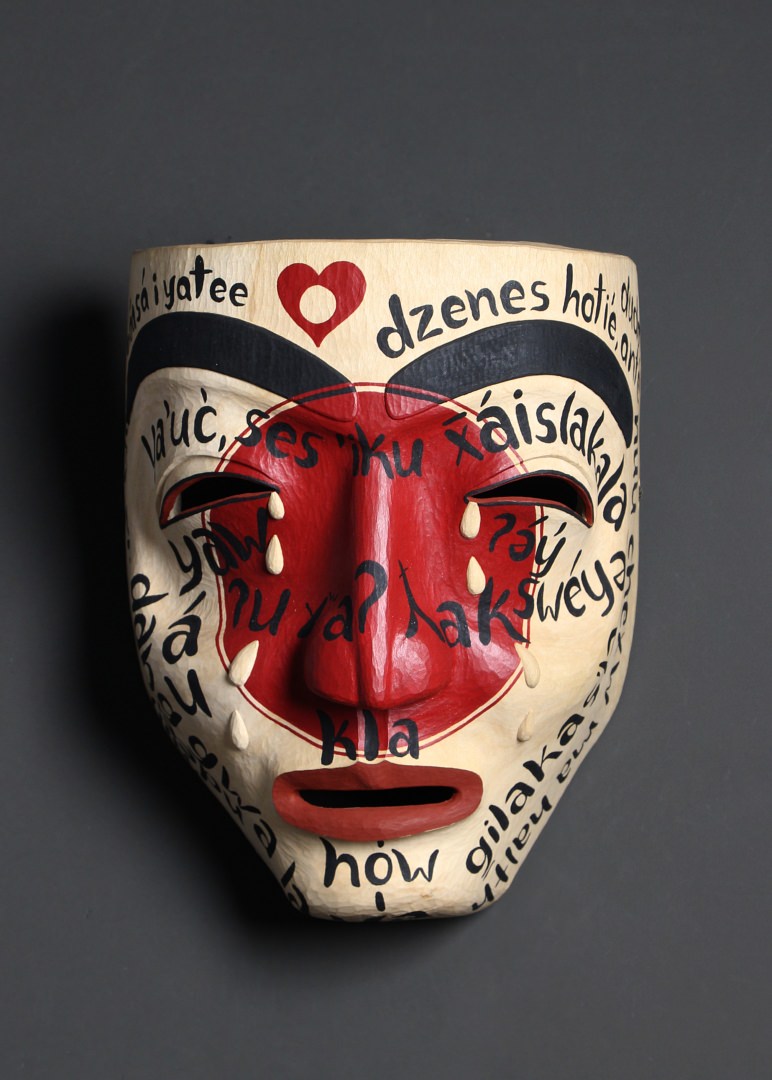
He has begun to incorporate these influences into his art. The most recent iteration is Mourning, a mask in the exhibition that features painted greetings from different major language groups all along the Northwest Coast—Haida, Tsimshian, Tlingit, Nuxalk, Tahltan, Nuu-chah-nulth, Hul’q’umi’num’ and more. “They’re all sort of similar because they’re very close together, but they’re all different,” he said.