“Every Picture Somewhat of an Experiment”: Helen Frankenthaler Prints
Henry Art Gallery, Seattle, WA - To April 24, 2027
The bequest of 26 prints and proofs by the Helen Frankenthaler Foundation to the Henry Art Gallery provides students and visitors with an ideal chance to learn more about the trailblazing Color Field painter as well as her experimental approaches to perfecting the art of printmaking through size and painterly effects.
Frankenthaler (1928–2011) is a major figure in the history of postwar American art. Daughter of a New York State Supreme Court judge and wife of New York School painter Robert Motherwell, she was eyewitness to the rise (and fall) of Abstract Expressionism and a central participant in its successor style, Color Field. During the Second World War, she and Motherwell were the only New York School artists fluent in French, so their home became a gathering place for exiled Surrealist artists and poets including Yves Tanguy, André Breton, André Masson, Salvador Dalí, Max Ernst and Roberto Matta. This interchange had a profound effect on the subconscious impulse associated with Abstract Expressionism.
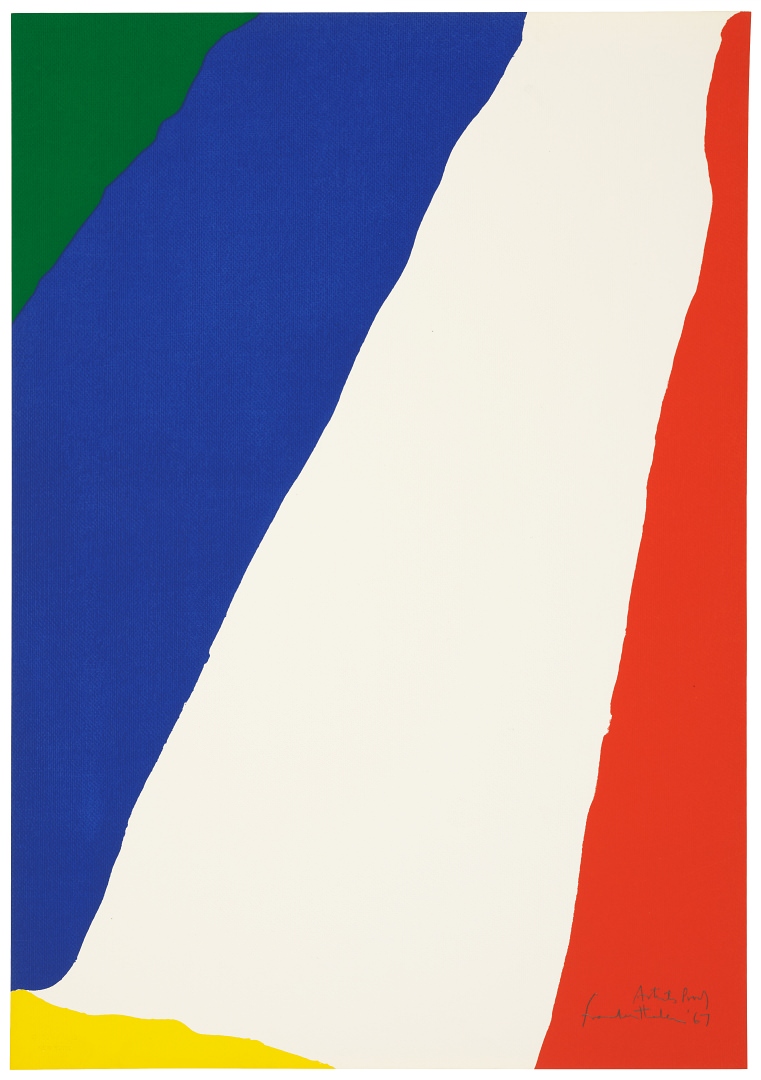
Seeing Jackson Pollock’s drip paintings at the Betty Parsons Gallery in 1951, with Clement Greenberg, inspired Frankenthaler to subsequently abandon the brush in favor of pouring, pooling and staining with thinly diluted oil and acrylic paint. In the 1960s, Frankenthaler adapted these techniques to printmaking, as in the silkscreen Untitled (1967), followed by multiples of increasing size, such as Tout à coup (1987), an etching, aquatint and drypoint measuring 83¾ x 41¾ inches.
Working over decades with master printmakers from New York to Barcelona
and Rome, in more than 300 editions,
Frankenthaler accentuated the immediacy and impulsive origin of each image despite the often time-consuming, laborious process required to achieve such an image. The rich, dense colors of the prints emulate her celebrated soak-stain paintings and advanced the possibilities of fine printmaking.