The Kondō Family: Storytellers in Clay
Seattle Asian Art Museum, Seattle, WA - To Jan 3, 2027
Kondō Yūzō was the grandson of a samurai disenfranchised by the Meiji Restoration. Seeking a profession where he could work independently, Yūzō studied ceramics. His sons and grandson followed in his footsteps, but each generation reinvented the work of the last. The Kondō Family: Storytellers in Clay illustrates the continuity and diversity of their respective practices. The youngest, Kondō Takahiro, is the most internationally renowned and his work makes up most of this exhibition. (Following Japanese custom, family names precede given names.)
With his mentor, Tomimoto Kenkichi, and later his son Hiroshi, Yūzō worked in the sometsuke style of white porcelain decorated with cobalt blue glaze. Traveling widely, both he and Tomimoto absorbed influences ranging from Korean moon vases to the sculpture of Aristide Maillol. Their renderings of the traditional motifs of landscapes, trees, fruit and flowers have a modern sensibility, their white vessels a voluptuous softness.
Yūzō’s elder son Yutaka ventured even farther afield. Although he was trained by Yūzō and Tomimoto, his style diverged. His stoneware pieces bear stamped or inlaid surface patterns drawn from Korean buncheong, and he pushed the limits of functionality. Yutaka left Japan for long periods to teach and travel. Described as a free but troubled spirit, he died by suicide at the age of 50.
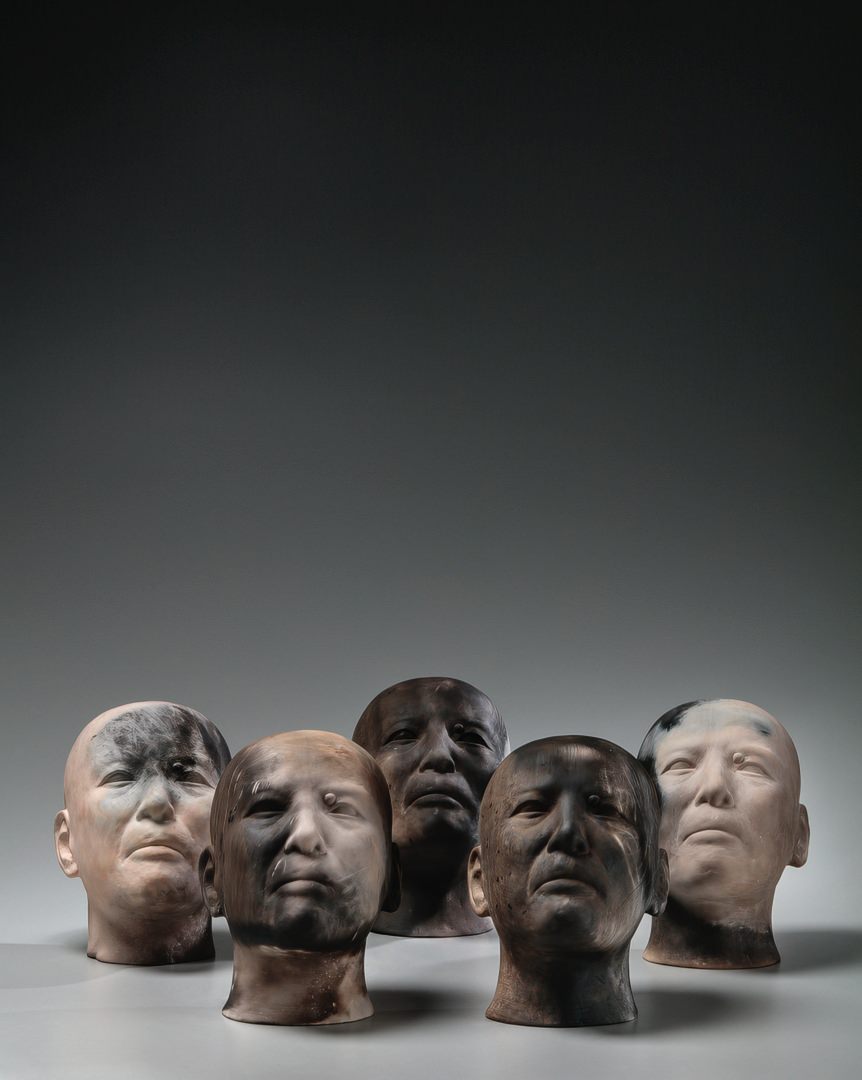
Hiroshi’s son Takahiro was a professional table tennis player, but after his uncle’s death, he rededicated himself to the family legacy, training with his father in the sometsuke tradition. Opportunities to exhibit internationally connected him with artists in other media and inspiration beyond the purely aesthetic. He learned glass casting in Scotland and transitioned from the potter’s wheel to hand-building and casting large-scale sculptures. His Monoliths series, combining glass and clay, is infused with the spirituality of a prehistoric stone monument. His Reflection and Reduction series of self-portraits speak to his uncle’s death and the Tohoku earthquake and tsunami. He employs traditional firing techniques and innovative metallic glazes to produce striking surfaces. Although clay is still his primary material, this later work transcends ceramics.
A catalog, Transcendent Clay: Kondō, a Century of Japanese Ceramic Art, is available.