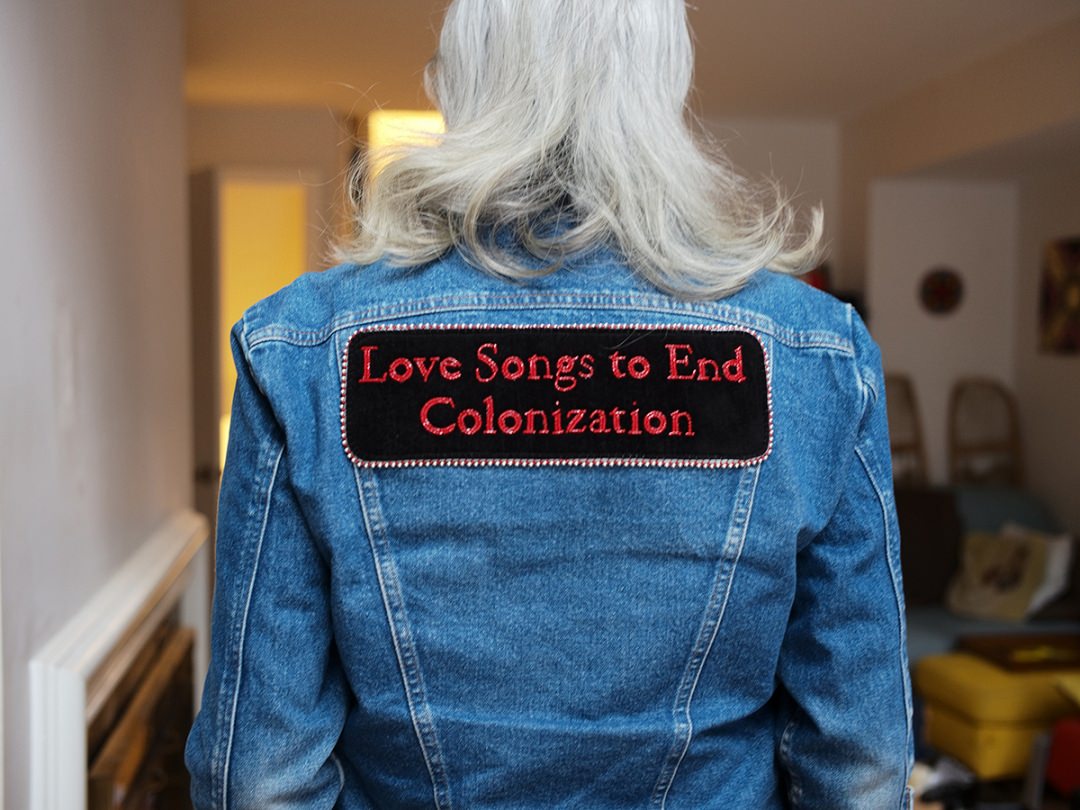
Love Songs to End Colonization
Open Space, Victoria, BC - To Oct 3
For the past four years, performance artists and friends Peter Morin and Jimmie Kilpatrick have been engaged in a project to break up with colonization in Canada. Their participatory karaoke project has taken them on many adventures—singing with people in galleries, streets and parks across the country, and even in an axe-throwing pub in Newfoundland.
They invite folks to consider how to use love songs to reframe their relationship to colonization in Canada, said Morin, and how, in the songs’ repurposing, karaoke can be a method for social change. “Usually these love songs are breakup love songs, and it’s like a stretching of the original words or the reframe of those original words,” he said. As they sing, the reframed song and its words begin to take on new meaning.
Morin, a Tahltan Nation artist, has long grappled with the concept of colonization, and the pain and trauma that have existed within Indigenous bodies as a result of the residential school system, through his artistic practice. For example, in a 2012 performance at the Victoria courthouse called A Button Blanket Dance, a Projected River, and a Courthouse, Morin stood in the judge’s chair, pushed his face up to the coat of arms on the wall, and sang “The First Cut Is the Deepest,” by Yusuf / Cat Stevens. “In that context of the performance what I’m saying is, when it comes to lovin’ me, Queen Elizabeth is the worst. And when it comes to lovin’ us, colonization is the worst.”
A multi-site project co-presented by the Art Gallery of Greater Victoria, Love Songs to End Colonization begins with a free performance in Beacon Hill Park on Aug 28. The exhibition at Open Space, curated by Tomas Jonsson, features neon signs with special messages reflecting in the shine of disco balls and mirrors, along with an archive of materials from past performances, among them beaded blue jean jackets and T-shirts made by karaoke collaborators and artists.