Eric-Paul Riege: ojo|-|ólǫ́
Henry Art Gallery, Seattle, WA - March 14 – Oct 25
Eric-Paul Riege is descended from generations of Diné weavers and trained in their traditional techniques. His work both builds on and toys with those traditions, challenging what we perceive as precious or authentic. His largest solo exhibition to date, ojo|-|ólǫ́ was jointly developed by the Bell Gallery at Brown University and the Henry Art Gallery at the University of Washington. Riege spent two years doing research at Brown’s Haffenreffer Museum of Anthropology and Washington’s Burke Museum of Natural History, mining their collections of Navajo art to create work for this exhibition.
Riege considers himself part of a living tradition that is both a continuum and a community. His home and studio are in the same family compound where he grew up, in Na’nízhoozhí (Gallup, New Mexico), bordering the Navajo reservation. Family members taught him to weave and sew, and they still play active roles in his artistic practice. He regards the people who make his materials as part of his creative process, whether they are shepherds and hand spinners or factory workers and shippers.
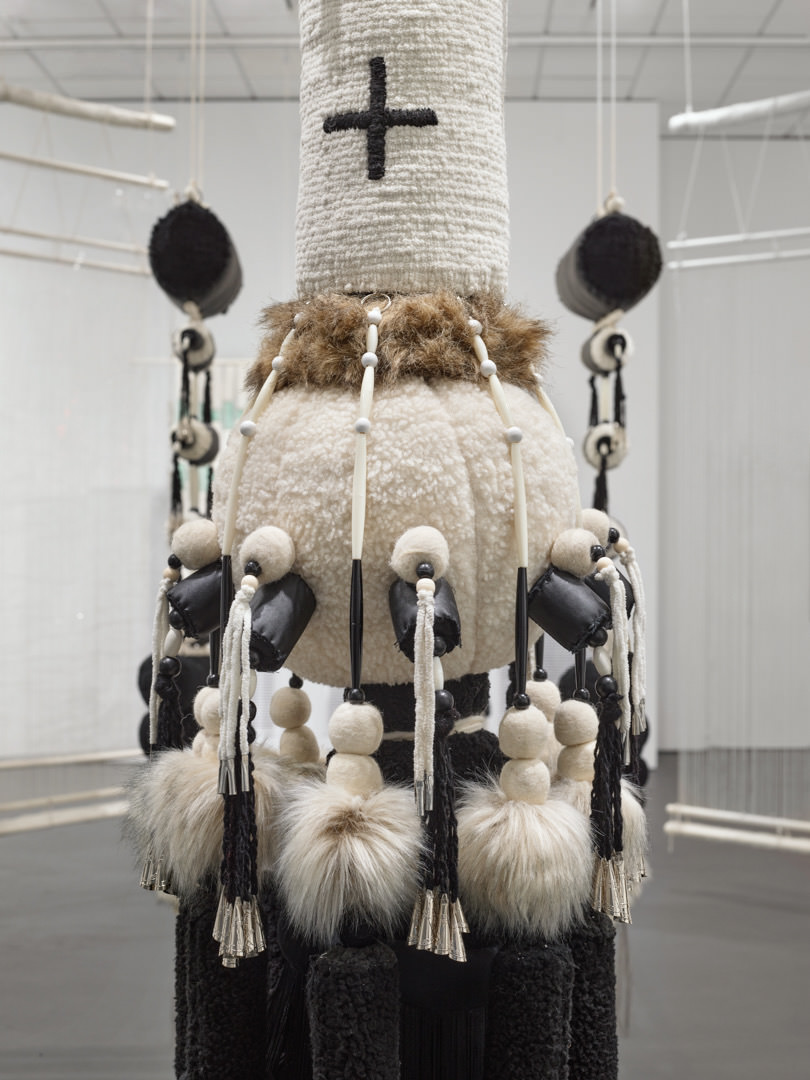
But the artworks themselves upend the tropes of Native American art. Jewelry, beading and weaving patterns are reproduced in monumental sculptures of unexpected materials such as synthetic yarn and fake fur. Many are suspended from the ceiling and none have individual titles, so the exhibition can be experienced as a single immersive environment. Riege also uses live performance as a medium through which he and his audience can interact with his work. Performances by Riege and guest artists will occur during the exhibition’s run.
ojo|-|ólǫ́ includes artifacts from the Burke collection and Riege’s personal archive, creating a conversation between past and present, real and fake. “A lot of my work is this interplay of questioning and celebration,” Riege has said. For each exhibition, he reconfigures existing works. Pieces are neither the same nor completely new, but in a sense alive and evolving. His use of soft materials and exaggerated scale makes the pieces accessible and approachable. But it also raises questions about how we attribute value or authenticity to materials and objects.