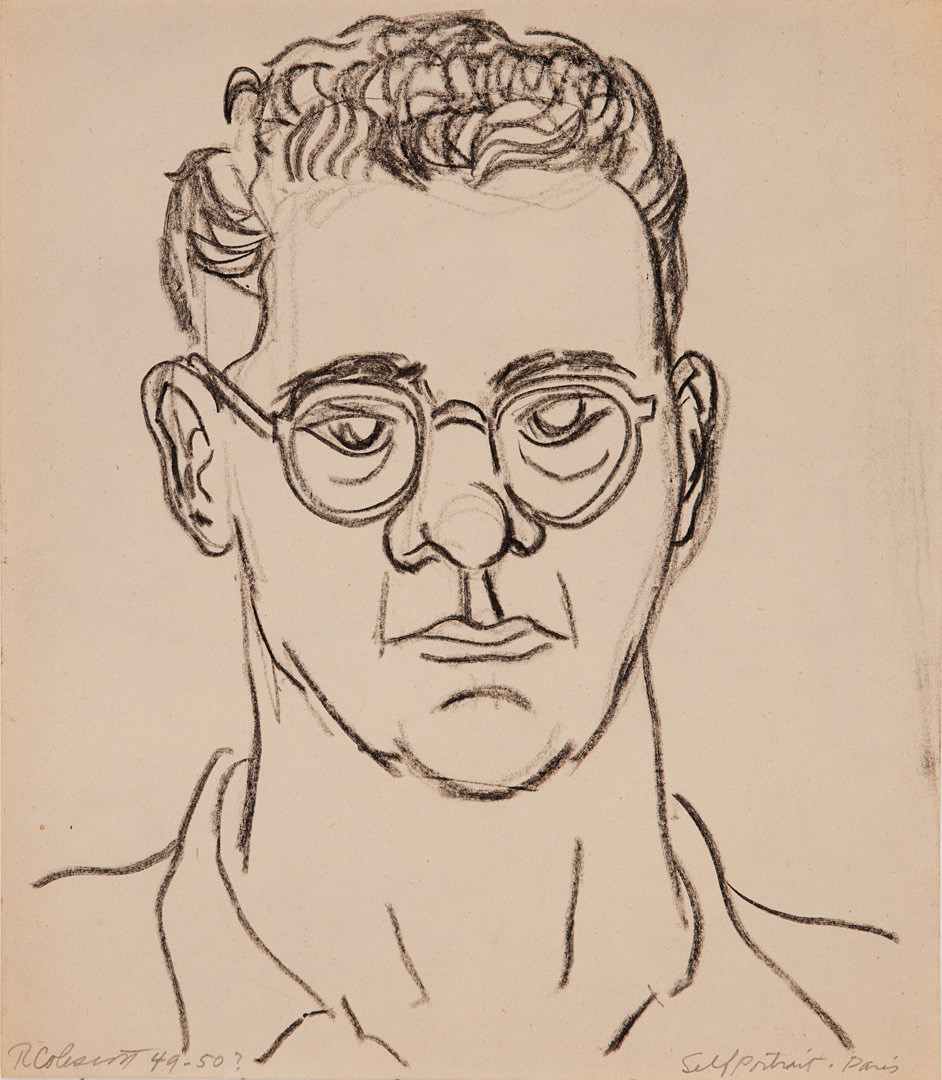
The One-Two Punch: 100 Years of Robert Colescott
Tacoma Art Museum, Tacoma, WA - To March 29
The celebrated African American artist Robert Colescott (1925–2009) spent substantial amounts of time in the Pacific Northwest before settling permanently in Tucson, Arizona. He grew up in Oakland, California, son of musician parents who had moved west at the start of the Great Migration. After serving in World War II, he studied at the University of California, Berkeley, and, prior to his 1952 MFA, with French Cubist master Fernand Léger in Paris. The emerging artist then spent time in Seattle, where he befriended artist Norman Lundin and taught at Queen Anne High School.
As we see in the centennial exhibition at Tacoma Art Museum, from the mid-1970s, Colescott examined in depth African and African American history with great humor, bitterness and satire in extravagantly colored canvases that often reconfigured masterpieces of European art, replacing white female nudes with Black, and stuffy white men with swaggering Black antiheroes. For example, Emanuel Leutze’s Washington Crossing the Delaware (1851) becomes Colescott’s George Washington Carver Crossing the Delaware: Page from an American History Textbook (1975). Visitors to Tacoma can easily trace the stylistic evolution of the artist’s figurative works, which call on Renaissance painting, Surrealism, Abstract Expressionism and Pop Art.
With his move to Portland and his first show at the Fountain Gallery in 1963, Colescott’s career began to take off. Time he spent in Egypt was formative. He said: “I was influenced by the narrative form of Egyptian art, by 3,000 years of a ‘non-white’ art tradition, and by living in a culture that is strictly ‘nonwhite.’ I think that excited me about some other things, some of the ideas about race and culture in our own country; I wanted to say something about it.” For his powerful, large scale paintings focusing on racial themes, he is now considered a forerunner of the 1980s art movement Neo-Expressionism.
Having gained recognition with his bold reinvention of history painting, Colescott had his first retrospective in 1987, a traveling show organized by San Jose Museum of Art director John Olbrantz, also from the Northwest. In 1997, Colescott became the first African American artist to represent the United States at the Venice Biennale.