That Green Ideal: Emily Carr and the Idea of Nature
Vancouver Art Gallery, Vancouver, BC - Feb 6 – Nov 8
This exhibition, the gallery’s largest presentation of work by Victoriaborn artist, writer and educator Emily Carr (1871–1945) in over two decades, comprises mostly paintings drawn from the VAG’s Emily Carr Collection, with an emphasis this time on Carr’s idea of nature as its “sole subject.” Taking its title from the artist’s journal entry of June 30, 1931, That Green Ideal explores this subject both in form and in content, providing insight into Carr’s method and process.
She writes: “Find the forms you desire to express your purpose. When you have succeeded in getting them as near as you can to express your idea, never leave them but push further on and on[,] strengthening and emphasizing those forms to enclose that green idea or ideal.”
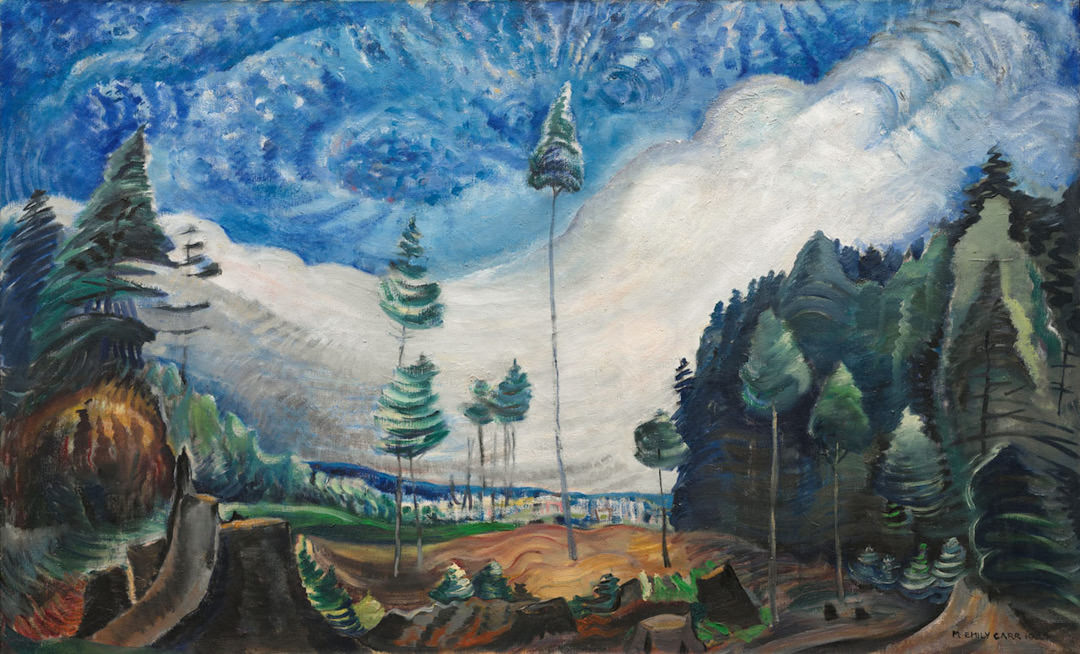
Those familiar with Carr’s paintings will recognize how her modelling of form led her beyond the Northwest Coast totem poles she sought to document and deeper into their biological source material—the abstracted, torqued forests of the 1930s and ’40s. Though Carr is best known for these swirling, shimmering forests, her solo trees best express the balance between formal interests (her monochromatic Grey, from 1929–30, inspired by her visit to Georgia O’Keeffe’s New York studio) and social concerns (the clear-cut known as Scorned as Timber, Beloved of the Sky, 1935).
In the words of exhibition curator Richard Hill, “What interests me is the extent to which Carr was not, intellectually speaking, alone in the forest as she conceived these works. I want to tease out the tension between the artist’s desire for direct communion with nature and the larger history of cultural and artistic ideas that she drew on.”